Free GMAT Course > Sentence Correction > Seven Error Types > 1. Subject-Verb Agreement > D. Plural / Singular
Basic rules for compound subjects:
1. Phrases or words separated by “and” are plural;
2. Phrases separated by “or” or “nor” are singular.

In this example, we see a list of three names. Because these names – Ted, John, I – are separated by the word and, the plural form of the verb is used. The subject is plural because it refers to more than one person (place, thing, or event), and plural subjects require plural verbs. When a list of things is separated by the word nor, the singular form of the verb is used.
Pronouns
A. The following pronouns are always singular:
anyone
anybody
anything
everyone
everybody
something
whatever
whoever/whomever
someone
somebody
something
no one
nobody
nothing
Many of the words in this category can be broken down in a way that illustrates their singular nature:

B. The following pronouns are always plural:
both
few
many
others
several
C. The following indefinite pronouns could be either singular or plural depending on context:
some
any
none
all
most
For the pronouns in list C, you can’t depend on memorization to tell you whether you need a singular or plural verb. Instead, you need to figure it out from the context. Look at these examples:
Some of the bananas are brown.
Some of the banana is brown.
Both sentences are correct. Why does the first require a plural verb and the second a singular? Because, in the first sentence, some refers to several distinct objects:

If we have ten bananas, then some of the bananas means many individual bananas. In the second sentence, some refers to part of one object:

One part of one banana is brown. In this sentence, some means one part (of a banana), which is singular.
The general rule applies:
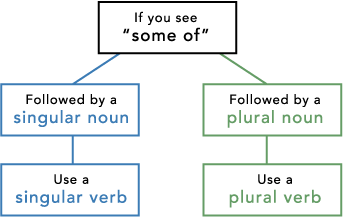
This trick works for the pronouns some, all, any, and most. These pronouns will almost always be followed by a noun or by the prepositional phrase “of + noun”: some of the dogs, most of the cake, any of the individuals, etc. In either case, you can use the flowchart above to determine which verb to use.
The same principle applies even if the verb comes before the pronoun in the sentence. This often happens with the pronoun any.


As in the other examples, the number of the noun determines the number of the verb. If a singular noun follows the pronoun, use a singular verb. If a plural noun follows the pronoun, use a plural verb.
Hint: If you are having trouble determining whether the noun is singular or plural, try replacing the noun in question with a pronoun. If the pronoun is singular (“it”), use a singular verb. If the pronoun is plural (“them”), use a plural verb.
The pronoun none follows slightly different rules. Consider these sentences, all of which are grammatically correct:
None of the ice cream was left over.
None of my friends are going to a play tonight.
None of the inmates was given a fair trial.
See something strange? The first and second sentences look fine, using a singular noun followed by a singular verb and a plural noun followed by a plural verb. But the third sentence contains a plural noun and a singular verb. How could this be?
Unlike agreement for the pronouns some, all, any, and most, agreement for none is not determined by the noun following it, but rather by context – whether the thing being spoken of is singular or plural. However, there are exceptions, so you should learn to use context to determine whether the quantity in question is singular or plural.
The first sentence takes a singular verb because the ice cream is being referred to as a whole. This sentence is talking about a certain quantity of ice cream. Single entities require singular verbs:

In the second sentence, the author is talking about the collective action of several different friends, so a plural verb is required:

Now let’s take another look at the third sentence, which takes a singular verb in spite of the plural noun:
None of the inmates was given a fair trial.
Here, the singular verb is used because the inmates are not being referred to collectively, but individually. The inmates are not tried as a group; they are tried as individuals. So, use a singular verb.


Find local GMAT classes & schedules using our database of over 150 cities.