2. Analyze Paragraphs
Break down each paragraph. Look for the main idea, tone, and transitions.

- The paragraph is the basic unit of the passage. By breaking down an unwieldy and cumbersome passage into smaller pieces, it is easier to comprehend ideas and intentions and to follow the organizational structure.
- When reading a paragraph and after finishing it, make a mental note or write down three things to help you answer the questions that follow: main idea, tone, and transitions.
If this all sounds familiar, that’s probably because the concepts in this lesson and the next three are identical to what is taught in ACT, SAT, LSAT, and GRE courses. These are generic concepts used in many standardized tests. Accordingly, we’ll use many well-produced videos from other standardized tests in these lessons.
A. Main Idea of Each Paragraph
The first sentence in a paragraph will often be a topic sentence or transition sentence. It often tells you the main idea of the paragraph or the paragraph’s relation to the preceding one. There is no good rule about where the author will put the main idea of each paragraph. However, there are indicator works that might indicate the author is revealing an opinion.
Slam-on-the-Brakes Language signals that you should slow down your reading pace and start reading very closely. There is a good chance the author is about to reveal central point, opinion, or transition.
Premise
- Because
- Since
- For example
Supporting Premise
- In addition
- Moreover
- Similarly
- Furthermore
Transition
- while
- still
- while
- consider
Sharp Transition
- But
- However
- Instead
- Despite
Counterpoint
- Contrary
- Deny
- Refute
- [contemptuous language]
Main Idea
- Therefore
- In conclusion
- Hence
- In sum
B. Tone of Each Paragraph
Recognizing an author’s tone is very important to understanding the structure and purpose of an essay. Having a strong grasp on the author’s tone will go a long way in answering main idea and author purpose questions.
Here’s the last paragraph from a passage about artistic concepts. See if you can cue in to the author’s tone to more easily discern his point:
- The mimetic theory holds that art reproduces reality, but although amateurs’ photographs reproduce reality, most artists and art critics do not consider them art. Much of what is recognized as art conforms to the definition of art as the creation of forms, but an engineer and the illustrator of a geometry textbook also construct forms. The inadequacy of these definitions suggests a strong element of irrationality, for it suggests that the way in which artists and art critics talk and think about works of art do not correspond with the way in which they actually distinguish those things that they recognize as works of art from the things that they do not so recognize.
The words “inadequacy” and “irrationality” establish an attitude of frustration over the current method of defining art. We can sense that the author is exasperated by the current practice of critics.
The words “inadequacy” and “irrationality” establish an attitude of frustration over the current method of defining art. We can sense that the author is exasperated by the current practice of critics.
Author's Tone Video Summary
- 01:52 – Writer’s convey tone through word choice.
- 02:40 – Each passage has a different purpose, point of view, and tone.
- 03:40 – Improve your reading comprehension by practicing determining the author’s message based on their purpose, point of view, and tone.
C. Transitions between Concepts
A good writer will make a smooth transition from one paragraph to another with a new idea. After each paragraph, mentally note its relation to the preceding paragraph. The paragraph is the main structural unit of any passage. To find a paragraph’s purpose, ask yourself:
- Why did the author include this paragraph?
- What shift did the author have in mind when transitioning to this paragraph?
- What bearing does this paragraph have on the main idea of the passage so far?
Tone can shift suddenly in a new paragraph. Watching for tone changes and transition changes allows you to more closely follow the author’s line of reasoning.
There are increasing indications that academic research has separated itself from practical concerns to such an extent that, in many academic arenas, the transition from theory to practice has vanished entirely. Indeed, public and private institutions alike are awakening to the need to infuse scholarship with an ‘ear’ for the practically useful. Yet, the problem appears intractable, with a chasm between academics and practitioners that only grows wider. Only radical change will steer academia back toward collaboration with practical concern. But who could devise such a radical, yet effective, strategy?
Play-by-Play
The first paragraph sets up the problem: academics have lost touch with real life.
I can. I have the answer. All academic research must seek private funding. Scholarship without funding has no justification for existence. You, naturally, think my idea is preposterous. Surely I understand that commercial value is separate from scholarly significance? Yet it is you who are mistaken. You do not understand that the market is the most efficient measure of worth, be it commercial or scholarly. You again object, this time almost in a panic, that I speak nonsense. But you are merely afraid of what you know to be the one viable path for modern academia. Follow or be left behind in your blind fear of the most fundamental economic truths. This is the only way.
Play-by-Play
The second paragraph signals a tone shift from explanatory to aggressively persuasive, reflecting a shift in purpose from explaining a problem to forcefully advocating a solution.
Once you can get a handle on individual paragraphs and how they interact, you can move on to mapping the entire passage.
Tone Questions
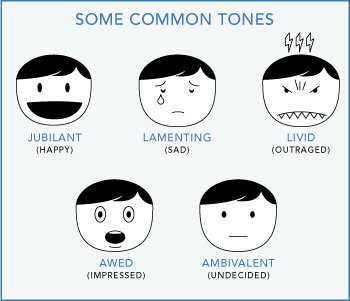
How to identify ‘Tone’ questions: Tone is feeling, not thinking. Look for emotion and attitude.
- What is the author’s attitude toward . . . ?
- Which of the following best describes the author’s feelings toward . . . ?
How to tackle them: Look for adjectives in the passage that describe attitudes, such as “jubilant,” “depressed,” “extraordinary,” etc. Also, remember that the tone must be consistent with the main idea.
Which of the following best describes the author’s feelings towards gentrification?
A) Outrage
B) Suspicion
C) Indifference
D) Acceptance
E) Exhilaration
Explanation
The author probably is not outraged or exhilarated about the subject. Both of these adjectives are extreme and would warrant much stronger language than what commonly appears in GRE passages. On the other hand, “indifference” is probably not accurate either, as it implies too little emotion: if the author doesn’t care at all about the topic, why would he write a passage about it? “Acceptance” and “suspicion” are much more moderate feelings, so it’s likely that either (D) or (B) is the right answer. Similar to main idea questions, tone questions look for answers that fit somewhere in the middle: neither too hot nor too cold.
What GRE score would you get? Take a free diagnostic GRE with video explanations and tutor support.